Unity in Diversity: Embracing Our Differences Through Christ
by Guest Contributor
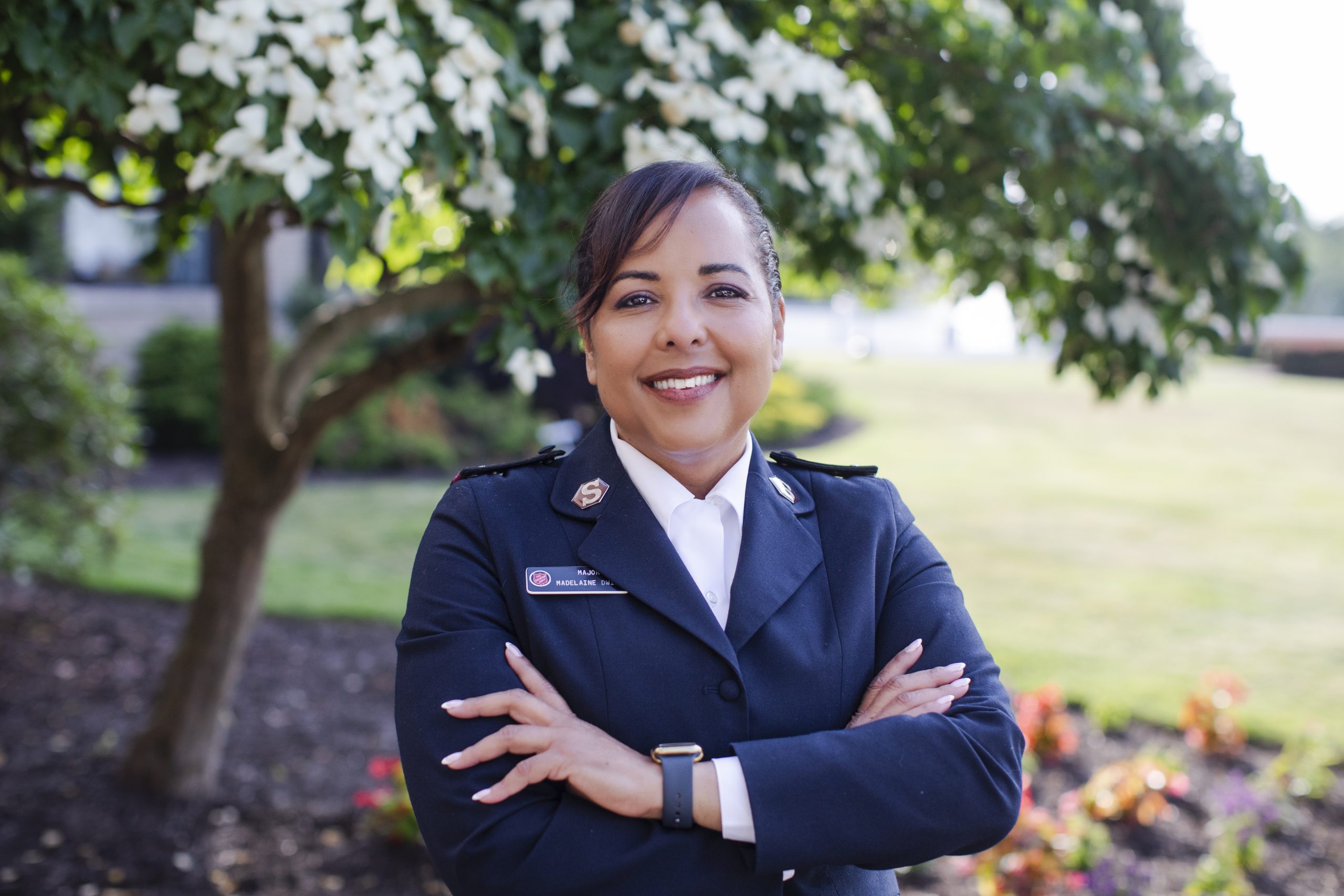
(Photo/Austin Wideman)
Guest Contributor: Major Madelaine Dwier
Major Madelaine Dwier, Divisional Commander for Southern New England, explores the tension between our unique backgrounds and the Apostle Paul’s declaration in Colossians that there is no distinction between Greek and Jew, slave and free, but that Christ is all and in all of us.
I want to talk about something that feels both deeply personal and universally challenging: our identity. We often define ourselves by our cultural markers—where we are from, our gender, our ethnicity. These things are important.
When we look at Colossians 3:11, the Apostle Paul tells us that in Christ, there is no Greek nor Jew, no slave nor free. I am an immigrant, a woman, a person of color. I love my identity. My accent tells a story, and my perspective is shaped by my background.
Christ does not negate our social markers; He redeems them. When we are in Christ, those markers are no longer the ultimate definition of who we are. Christ becomes the anchor of our identity.
Embracing our differences
Paul tells the Colossians that the people they once were are now dead in Christ. A new people have come, and the Kingdom of Christ is being established. And in this new Kingdom, he says, “there is no Gentile or Jew, circumcised or uncircumcised, barbarian, Scythian, slave or free.”
These cultural and ethnic distinctions that Paul mentions carried a heavy connotation in the society of the Colossians. They determined the value of a person and their social advantage. So, what Paul is saying to them was truly shocking because their society was built with these very clear ethnic and social categories.
When Paul says, there’s none of that anymore, it is shocking. He is declaring that none of these markers grant superiority or inferiority or permission to dominate or dismiss another.
Personal distinctions
Markers define who I am. Tropical brown is my color. Latina. For better or worse, being Dominican is part of my identity.
Every time I speak with my accent, it tells a story that is louder and deeper than the words themselves. Every time I express my opinion, I do it from the lens of my background.

Major Madelaine Dwier is proud of her accent and her Dominican roots. But she believes that as Christians, we are all one in Christ, no matter our unique backgrounds. (Photo/Austin Wideman)
My point of view is different from your point of view because we are distinct based on where we’re from. So how do we reconcile these things? Well, this Scripture tells us that when we are in Christ—grasped by Him, renewed by Him—no nationality, ethnicity, or social identity is sufficient to define us fully. These markers matter, but they are not enough.
Social markers do not capture the essence of being a human, and they do not capture the essence of the Imago Dei, the image of God. And even more than that, they do not capture the new nature that we have obtained when we are in Christ.
Christ: in all, above all
“Let’s have a week of social and cultural awareness. Let’s be polite about it.” That’s not what Paul is saying. He is announcing a revolutionary thought here. He’s saying: Now that you are in Christ, we are building the Kingdom of God, and it is different than the kingdom of earth.
The markers don’t matter as much as this fact: Christ is in all. That’s what matters.
So, what do we do with cultural diversity? What is its place in the Kingdom of God?

(Photo/K Soma/Unsplash)
Three truths about diversity
There are three truths that we should bear in mind about our diversity.
1. God created diversity intentionally to reveal Himself to us.
Scripture affirms variety from the beginning. Creation itself is diverse in form, sound, design, and purpose. Cultural differences are not an obstacle to unity. They are expressions of God’s imagination. When we honor someone’s cultural heritage, we are not just being polite. We are honoring the God who shaped that culture.
We are also honoring God. Think about it this way. Is there someone in your life whose background made a difference in the way you see God? Probably there is. Maybe they spoke about God or said Yahweh differently. Maybe the way they sang or moved their bodies in worship impacted you.
You know why that is? Because God invented diversity so we can see facets and aspects of Him within our diversity.
2. Sin distorts diversity into division, which shows up in very subtle ways.
Where God intended richness, humanity often will choose rivalry.
As I mention biases, assumptions, stereotypes, and fear of things that are different, perhaps you’re thinking, Oh, she’s going to go there. I am not saying it to condemn, but to create an honest starting point for all of us, including me. Yes, I have my own biases, opinions, and stereotypes.
As part of our Christian growth, the Apostle Paul is encouraging us to allow the Holy Spirit to reveal the walls between us that we don’t even realize we’ve built with words, with opinions and stereotypes. Paul goes on to describe how we should relate to one another when we allow Christ to be the defining factor in our lives.
So, how do we stop allowing diversity to cause division?
- By practicing humility (“My culture is not better than yours”).
- By resisting defensiveness (“This is not about me”).
- And by being willing to learn from each other’s experiences (“Tell me more about that”).
3. Christ redeems diversity for unity.
Christ doesn’t erase culture. He elevates it. In Christ, diversity becomes a source of fellowship and testimony, not of tension and division. The early Church was culturally mixed.
It was rich in culture, and it was messy. We know that. Yet that mix became the evidence of the power of the gospel, which was heard in the entire known world.
Unity is possible with Christ because Christ Himself fills the space between us. It is not the work of a cultural awareness week. It is a posture that we must take for a lifetime, and Christ has already supplied each one of us with what we need to live.
His Kingdom will be done
So, where do we go from here? How do we make the reality of every tribe, and every nation, and every language something that is here today rather than in the distant future?
We must love across our differences and see Christ first in every person. We choose curiosity over assumptions, and we honor the beautiful story behind every person.
We advocate for people whose voices are overlooked, using our influence to lift each other and create spaces where they can be seen and heard. And finally, we must live as Kingdom citizens today. We belong to a multicultural Kingdom, and we should let our daily interactions reflect that. We are intentional about forming relationships outside of our comfort zone.
I love being with my Dominican people. We eat tostones, avocados, and rice every day. But some friends invite me to come over, and they offer some delicious pastries. We see the differences, and we enjoy ourselves. I intentionally look for people who are different from me so I can see Christ in them, as they see Him in me.
Father, we recognize that we are at our strongest when we stand united, not because we are the same, but because Christ lives in all of us. I pray, Father, that you will open our eyes to see Your beauty in one another. That our unity will be the light that will point people straight to Christ. May our cultural awareness continue to grow, that You will develop in us a hunger, a thirst, and a deep desire for Your Kingdom to come in us now.
About the Author: Guest Contributor