Different Songs, One Mission
by Hugo Bravo
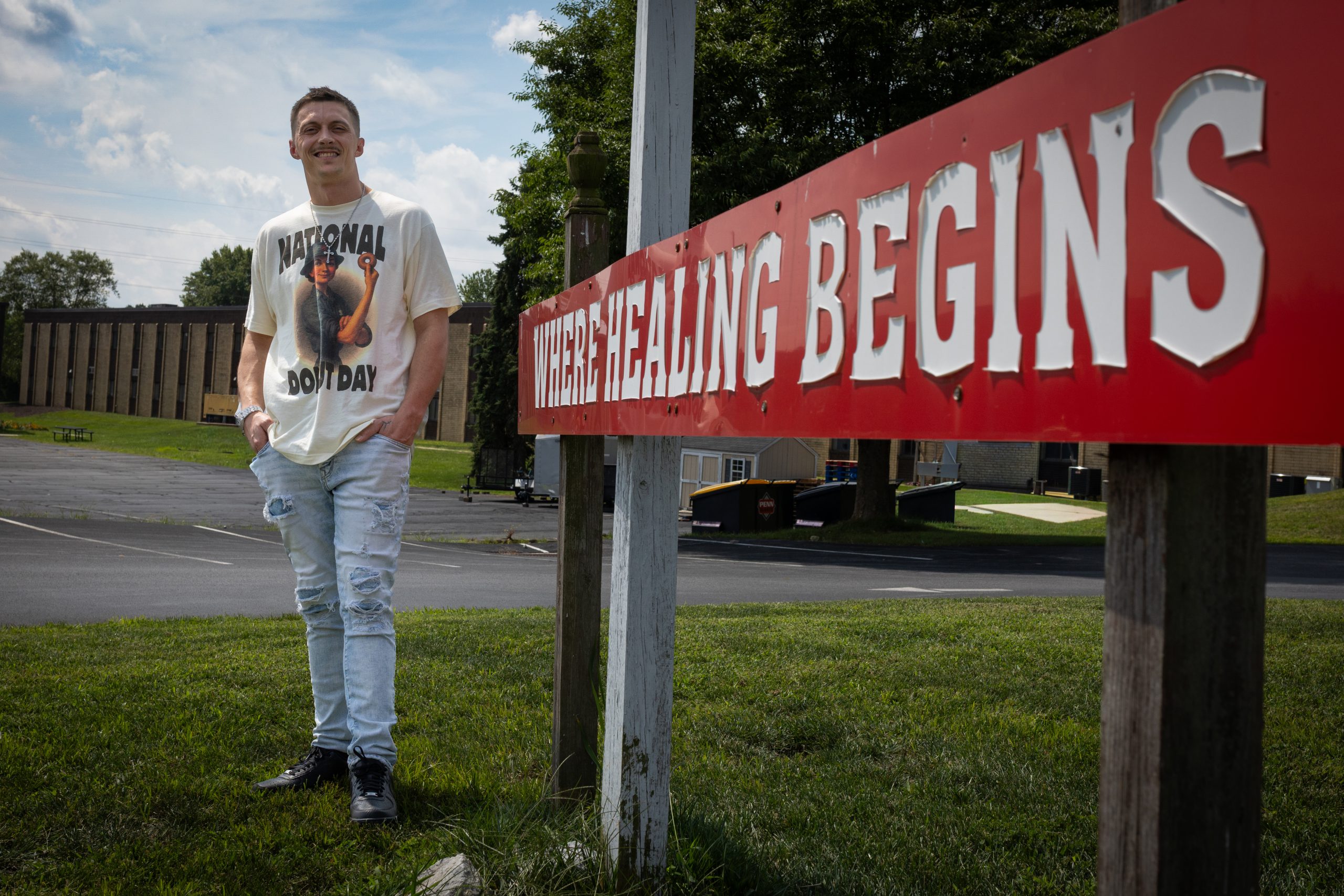
Spencer Deimler is a graduate of the Adult Rehabilitation Center program but returns to take part in the choir at the ARC in Harrisburg, Pennsylvania.
(Photo/Jeff Bruce)
Music and the musicians who share their gifts through The Salvation Army Eastern Territory are teaching new skills, inspiring creativity, and transforming lives.
Walk into a Salvation Army corps in the Eastern Territory, and chances are that you’ll encounter music being played, listened to, or discussed in terms of ministry.
In Columbus, Ohio, a professional jazz singer gets ready to welcome children at a Salvation Army summer day camp. Still on an emotional rush from last night’s live performance, she sets aside some food and toiletries from the pantry next to her office, knowing that a family who sends their child to the camp requested a food bag yesterday. Then she starts planning ways to incorporate a music lesson with the week’s activities.
At The Salvation Army Boston Kroc Center, in another summer program, a girl listens to her voice on professional recording equipment for the first time. Hearing her words against a hip-hop beat makes her smile. Soon, other children in the recording studio are repeating the lyrics she wrote about her favorite things to do in the summer: eat ice cream and visit the Kroc’s outdoor splash pad.
A man working toward rebuilding his life at The Salvation Army’s Harrisburg Adult Rehabilitation Center (ARC) in Pennsylvania recites the lyrics to a worship song. At first, he didn’t see how singing could push him forward on the path to healing. He did not even think of his own voice as a singing voice. But none of that matters now. He closes his eyes and joyfully sings to praise God.
William Booth, Founder of The Salvation Army, understood that the ability to create music, as well as to hear it, was a powerful tool for God’s Army. It could draw people in. To Booth, it didn’t matter if the song was a spiritual hymn, a brass band composition, or a jolly tavern sing-along. All three could bring souls to the Lord, Booth believed, if presented with the same love as a warm meal or a place to sleep for the night.
A calling in Columbus
Jasmine Spitzer’s first encounter with The Salvation Army was during the 2011 Souris River flood in her home state of North Dakota. Delayed snowmelt from winter and high rainfall in spring caused severe flooding in June. Over 10,000 people were evacuated in Minot, North Dakota. The Salvation Army Emergency Disaster Services (EDS) arrived, ready to serve in any way they could.
Though her own family’s home was not affected, Spitzer’s parents, both music teachers, had students with displaced families. Sixteen-year-old Jasmine and her family spent the summer serving food out of Salvation Army canteens.

Jasmine Spitzer packs a backpack with school supplies during The Salvation Army Columbus Area Services back-to-school event. (Photo/courtesy of Jasmine Spitzer)
“I had a sense of joy and relief that I could help others, and at the same time, I felt pain watching the people of my community suffer like this,” remembers Spitzer. Attending Minot State University, Spitzer continued to be involved with the town’s Salvation Army corps, participating in community service projects to raise money for its Christmas Angel Tree ministry. During her second year, Spitzer transferred to Ohio Wesleyan University to study jazz saxophone, classical voice, and music education, intending to follow in her parents’ footsteps as a music teacher.
Once she graduated, Spitzer taught music while still writing and performing at jazz festivals and other events. But after nearly five years of teaching, she decided to leave it behind. Seeing the need in her students’ families and the lack of resources available to help them weighed heavily on her.
“I could easily teach a classroom of 16 kids to play the trumpet. But what need was I meeting? The system was broken, and I couldn’t fix it from the inside,” she says. “Music has always been a part of my life. I connect through it. But sometimes what we love to do isn’t what we’re called to do.”
Her mother suggested that Spitzer apply to be the Learning Center director for The Salvation Army in Columbus, Ohio. She met Majors Philip and Jodi Lloyd, who had recently been appointed Columbus Area Commanders. The officers had heard about the need for no-cost childcare from the Columbus community. Meanwhile, the schools, with their limited funding, were asking for avenues where students could receive supplemental education.
Jasmine Spitzer says the arts helped shape her childhood, and now she is helping introduce them to a new generation as the Learning Center director for The Salvation Army in Columbus, Ohio. (Photo/courtesy of Jasmine Spitzer)
“The Lloyds had a plan for growing the Learning Center. My position had previously been part-time. It would now be full-time, with the goal of improving Learning Centers in the five Salvation Army corps under Columbus Area Services,” says Spitzer.
“At my interview, I said that I was looking for both the next step in my career and in my faith. I wasn’t sure what either of those looked like for me. What was my ministry?”
Now Spitzer is serving the families of the students she once taught in school. Through summer and after-school programs at the Learning Center, she can continue to introduce young people to music, art, and dance—all the things that shaped her own childhood.
“Music and arts education is so important,” she says. “It teaches you how to collaborate with others, improvise, think ahead, and so many other crucial life and work skills.”
Spitzer is also in her third year of a monthly residency at the Ginger Rabbit, Columbus’ only major jazz lounge, where she has even recorded a live album. Being able to continue her musical career while building her ministry, she said, is an answer to prayer.
“With The Salvation Army, I’m doing work serving and meeting the needs of others, and I can see the results right in front of me,” says Spitzer. “It’s work that leads to living the life that Christ asked us all to live.”
Inside the studio
During an outdoor festival hosted by The Salvation Army Ray & Joan Kroc Corps Community Center in Boston, Robert Bennett, the Kroc’s business operation director, chatted up an old acquaintance: Kavayah Wright, an experienced music producer, performer, and educator based out of New England.
“Rob talked about collaborating on a project at the Kroc,” says Wright, whose family includes music legends—members of Kool & the Gang (“Celebration,” “Jungle Boogie”) and Betty Wright (“Tonight Is the Night,” “Clean Up Woman”).
That conversation would grow into a program, A.M.P.S., that brings Wright’s musical gifts to the Boston Kroc. A.M.P.S. (Audio, Music, Production & Storytelling) is a six-week pilot program teaching children as young as 6 to record, edit, and perform original projects in the Kroc’s recording studio.
“A program like this isn’t something that just pops up overnight,” says Wright. “But it is something that I have a lot of experience running. I’ve taught lessons like these at summer camps, community centers, and high school radio and TV departments. In high schools, I taught the video students how to do audio, because you can’t have good video without good sound.”
When he first saw the studio built on the second floor of the Kroc, with its glass-enclosed booth, professional recording equipment, and soundproof walls, Wright was impressed.
“We could really get something done here,” he remembers thinking.
“I imagined that the Kroc would bring in some of the older teens that play basketball here to try the program. The kids that came to the first class were much younger than that.”
But music is a language, and children learn languages quickly. Wright starts with the very basics, such as how to connect a microphone to an audio channel.
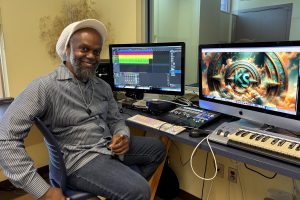
At the Boston Kroc Center, Kavayah Wright teaches children about music production and recording. (Photo/Heather MacFarlane)
“One of the goals before anything is to make kids feel comfortable with so much technology around them,” says Wright. “Kids can either be shy and afraid to touch anything, or they want to press every button and hit every switch. Finding that fine line is a form of discipline, and it carries over to other things in life.”
From there, Wright introduces the themes of A.M.P.S. First is Audio: how sound goes from voice to a computer. The students are introduced to wave forms and even some equalizer settings, like what they see in their parents’ car stereos. Next is Music, specifically reading music. They learn how to find notes on a keyboard and combine them to create chords. They discuss the feelings and emotions that come with different chords.
“P, Production, is putting that knowledge of the audio and the music to use, which creates S, the song, or the storytelling aspect of creating art,” says Wright.
When Wright and his students produce a beat together, they all know where to find a snare or a hi-hat. They can zero in on specific instruments in a song or in an orchestra, even if they’ve had little to no music education before coming to A.M.P.S. and meeting “Mr. K.”
“I’ve worked with students with learning disabilities,” says Wright. “I have a student who is on the spectrum, but he can play songs completely by ear after just listening to them. Another student in my class is nonverbal, but she has excellent rhythm. Even more impressive, when she steps into the recording booth, her voice comes out in song. And when children hear their own voices in a song, their minds are blown away.”
Wright has raised his own family doing what he loves: creating music, touring, and performing. Today, he’s investing those same gifts in children who may one day use them beyond the Kroc’s recording studio, from producing music for Sunday service to playing in a Salvation Army band.
“I hope to see that,” Wright said. “I’ve played and toured with major artists around the world, but I’ve also played in churches along the entire East Coast for over 35 years. I’m aware of the power music has in ministry and worship.”
Choir requirements
On her way to this summer’s Old Orchard Beach (OOB) Camp Meetings, Major Evelyn Wilson, administrator and pastor at The Salvation Army Harrisburg ARC, stopped at ARCs in Springfield, Massachusetts, and Portland, Maine. There, she rehearsed with members of the ARC Chorus who would be performing that weekend at OOB. Once at OOB, she held a united rehearsal to bring all the singers together. Saturday night, and again on Sunday morning, beneficiaries from ARCs in Boston, Worcester, Providence, Portland, and Springfield took the stage at the OOB Pavilion.
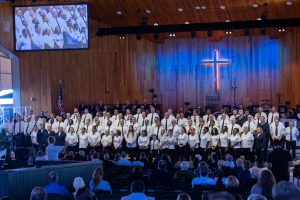
Under Major Evelyn Wilson’s guidance, beneficiaries and officers from Salvation Army Adult Rehabilitation Centers across the Eastern Territory perform at the Pavilion during the Old Orchard Beach Camp Meetings in Maine in July 2026. (Photo/Lu Lu Rivera)
“It’s exciting to watch these men and women go from being nervous to excitement about singing,” says Wilson. “They learned their songs very fast. A lot can happen in just two hours of practice.”
One of the songs the ARC Chorus performed was “Made for More” by Christian singer Josh Baldwin. The song reminds listeners that God has a plan for each of us despite our past mistakes and that, in His eyes, redemption is always possible. For men and women walking the road to restoration—and for Wilson, who leads them in song—its message couldn’t be more fitting.
“My husband [Major David Wilson] and I have had ARC appointments in Hartford, Philadelphia, Manhattan, and Scranton. No matter where we’ve served, we’ve had a choir,” she says.
Under the Wilsons’ ministry, choir participation in the beginning, Phase 1, is required for all beneficiaries. After finishing that, they can decide whether to continue in the choir during Phase 2. Wilson says many opt in.
“We’ve had ARC alumni who come back to continue singing long after graduating from the ARC,” says Wilson. “Some of them had never performed or sang before coming to The Salvation Army, but they find that they love doing it. It becomes a part of their success story.”
One of those success stories belongs to Spencer Deimler, a member of the Harrisburg ARC Chorus.
“Worshiping through music was new for me, but now it’s something that I both enjoy and puts me in service to others. I love encouraging others to sing and showing them how much fun it is,” Deimler says.
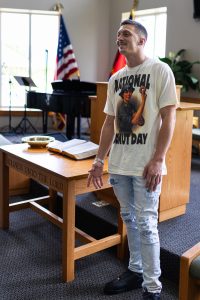
Going through The Salvation Army’s Adult Rehabilitation Center program, Spencer Deimler learned to worship through music. “I love encouraging others to sing and showing them how much fun it is,” he says. He also helps ARC beneficiaries with reading and writing in his free time. (Photo/Jeff Bruce)
After finishing the ARC program, Deimler, along with his choir duties, found employment at the ARC as a breakfast and lunch cook. Cooking, like singing, came with a learning curve. But being part of the choir had already taught him traits needed in the kitchen: patience, collaboration, and the courage to keep trying.
“I had never managed a kitchen where people were developing their own work ethic and seeking their path with God,” says Deimler. “But singing and cooking have helped me as well. One prepared me for the other.”
“Spencer is a true success story of the Harrisburg ARC,” Wilson says proudly. “In his own free time, he helps others in the ARC who have trouble reading or writing. He has risen to every challenge he’s faced and still finds ways to give back.”
Music, Wilson says, is a vital part of their worship services.
“Because we have such a diverse congregation, we sing traditional Army songs and contemporary music,” she says. “Sometimes we sing quietly, and other times we sing loudly. But no matter what or how we sing, I always warn the beneficiaries that singing is contagious. It has a way of reaching people with different voices and different styles. It helps face fears and builds connections with each other.
“And it’s also great practice, because one day, we’ll all sing together in Heaven. We might as well start rehearsing down here on earth.”
More than music
Music has a distinct way of affecting us. Even a snippet of a track from a beloved artist can immediately elevate our mood. A familiar song can bring us back to a time in our lives we may have long forgotten. Hearing a vocalist hit a soaring note can be as thrilling as watching an athlete achieve greatness.
But when music filters through the mission of The Salvation Army, as in these examples, it does more. It introduces a new calling to a dedicated servant, helps a young person find her voice, or gives someone working toward their recovery a reminder that God is with them every step of the way.
The melodies may be different. The locations and tools may change. But wherever music becomes a pathway to hope, healing, and faith, it becomes more than just song.
About the Author: Hugo Bravo