On Track for Service
by Warren L. Maye
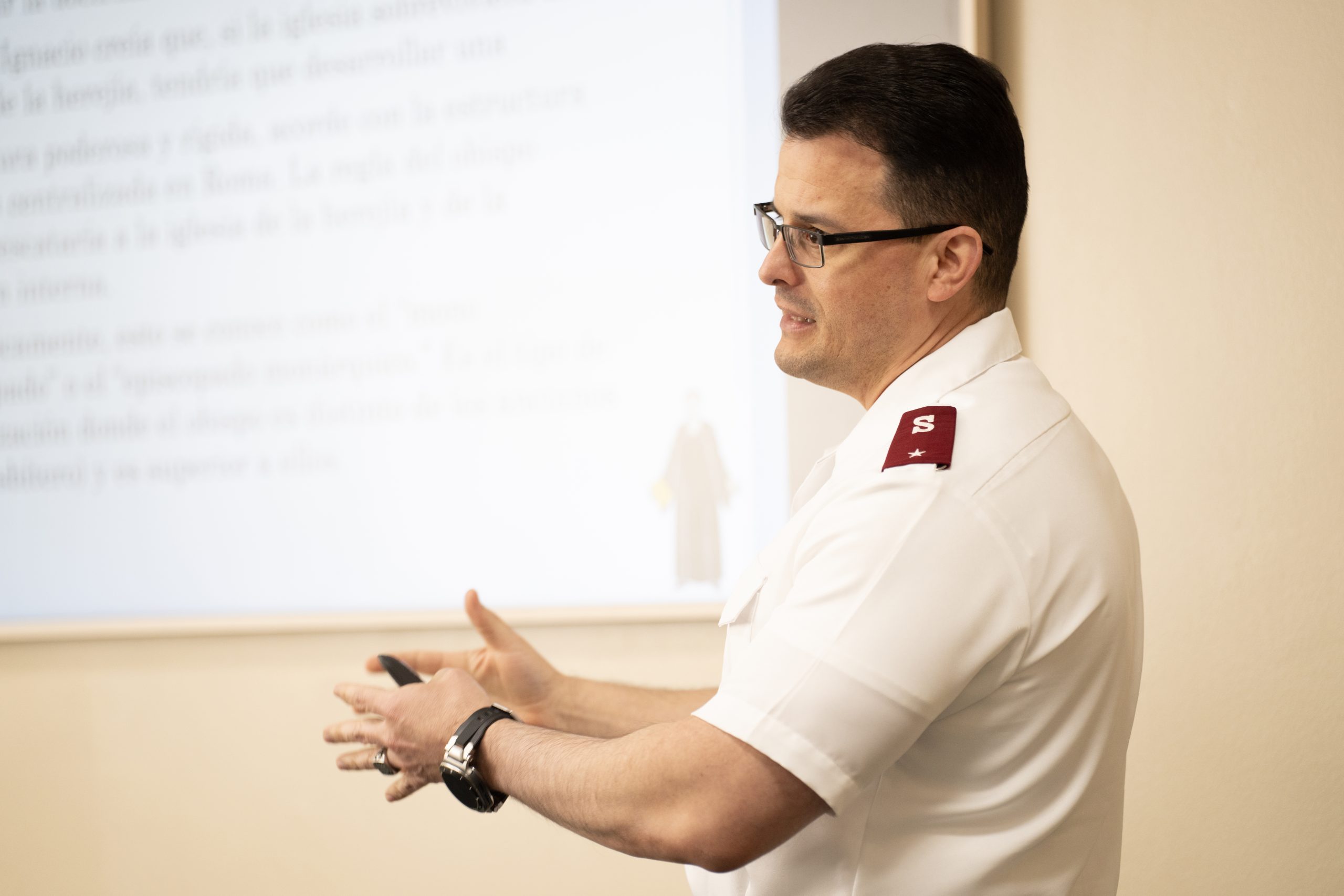
Language can be a barrier, which the Spanish Track removes. “It is very hard to study complex theology in a second language. Nuances get lost,” says Lieutenant Renato Sarmiento, Curriculum Officer for the Spanish Track at the College for Officer Training. When cadets learn, in their primary language, they develop a stronger foundation for ministry. (Photo/Eli Morgan)
Exploring the evolution and impact of the Spanish Track at the College for Officer Training.
When Yoelicet Vega arrived at the College for Officer Training (CFOT) in 2019, she faced more than the usual challenges of cadet life. She was navigating a new country, learning a new language, and stepping into a calling that felt clear in some ways, but uncertain in others.
At times, she remained quiet in class, unsure of her voice and hesitant to participate. Today, she is Lieutenant Yoelicet Vega, and she helps guide and shape cadets on that same journey.
Her story reflects something larger that is unfolding at CFOT in the USA Eastern Territory. The Spanish Track has become a vital and fully integrated part of the college’s mission—one that is forming confident, culturally responsive leaders. They are prepared to serve on an increasingly diverse ministry landscape.
A holistic approach to learning
Vega’s journey helps bring the Spanish Track into focus. When she began training as a recent immigrant from Cuba, her limited English proficiency made the academic experience difficult. Cultural differences added another layer of uncertainty. They even influenced how she viewed the Salvation Army uniform.
Growth did not come all at once. It came step by step.

Lieutenant Yoelicet Vega at a Spring Welcome Back Chapel at the College for Officer Training (CFOT) in Suffern, New York. Vega arrived at the CFOT in 2019 as a recent immigrant, navigating a new language and culture. Today, as a Mission & Ministry Training Officer, she helps guide cadets on their journey. (Photo/Eli Morgan)
Through consistent encouragement and instruction in her heart language, Spanish, Vega began to find confidence. Faculty and staff created space for her to learn, ask questions, and engage. Over time, her mindset shifted—from hesitation to willingness, from uncertainty to trust.
By the end of her training, she had emerged as a confident officer, prepared for ministry and grounded in her calling. Today, she serves in the CFOT Mission and Ministry Training Department, walking alongside cadets who face similar challenges. Her message is simple and personal: “If I could do it, you can too. It’s not because I am the best. It’s because God is with me.”
A program shaped by purpose
The Spanish Track itself reflects a similar journey of growth. Established in 1990 by then-Captain Marta Marzán to serve the needs of Spanish-speaking candidates, the program steadily developed into a fully integrated part of CFOT life. By 1997, it was running alongside the English curriculum, signaling its importance within the college. By 2020, the program celebrated its 30th anniversary.
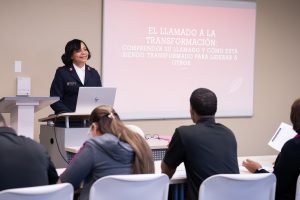
Major Raquel Ramirez, Spanish Studies Coordinator at the College for Officer Training, speaks about the “Call to Transformation” (El Llamado a la Transformación) during Candidates’ Seminar Weekend 2025. (Photo/Eli Morgan)
Today, the program is no longer viewed as a parallel or translated experience. Instead, it is a contextualized model of training rooted in language, culture, and mission.
Major Raquel Ramirez, the Spanish Studies Coordinator, describes her role as one of stewardship—guiding and strengthening a program that continues to evolve while remaining aligned with CFOT’s mission.
“Our guiding vision for the Spanish Track,” Ramirez said, “is to disciple, educate, council, equip, and empower Spanish-speaking cadets as they prepare for faithful and effective ministry in the Eastern Territory.”
Learning in the heart language
One of the most significant developments within the Spanish Track is the shift from translation to direct instruction in Spanish.
In earlier years, much of the coursework relied on translating English materials. Today, cadets are taught by Spanish-speaking instructors who address theological concepts and ministry practices in culturally meaningful ways.

Lieutenant Renato Sarmiento, Curriculum Officer for the Spanish Track at the College for Officer Training, leads a discussion. In their heart language, “Spanish cadets can ask the hard questions,” he says. (Photo/Eli Morgan)
Lieutenant Renato Sarmiento, a Spanish Track instructor, emphasizes the importance of this approach. Complex subjects—such as theology and biblical interpretation—require depth of understanding. When cadets learn in their primary language, they can engage more fully.
“Spanish cadets can ask the hard questions,” Sarmiento said. And they develop a stronger foundation for ministry.
Forming the whole person
Academic strength is only one part of the program’s focus. The Spanish Track is designed to support the whole person—integrating intellectual growth, spiritual development, and personal formation.
Cadets are encouraged to deepen their understanding of Scripture. As they prepare thoughtfully for preaching, they also engage in meaningful ministry experiences. At the same time, they receive mentorship and pastoral care that supports their personal and spiritual journeys. This holistic approach prepares cadets to succeed in the classroom and to serve effectively in the field.
Working together
The strength of the program is also reflected in its leadership. Director of Curriculum Captain Emeline Watch, who has a doctorate in education, oversees the entire effort. Major Ramirez provides vision and direction. Lieutenant Sarmiento brings academic depth and theological clarity. And Lieutenant Vega offers cadets practical insight and relational support rooted in her own experience.
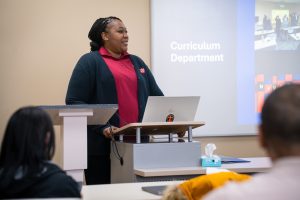
Director of Curriculum Captain Emeline Watch speaks during Candidates’ Family Weekend at the College for Officer Training. (Photo/Eli Morgan)
Together, they model a collaborative approach to formation. Their shared leadership ensures that cadets receive a balanced education—one that connects classroom learning with real-world ministry.
Creating a safe and supportive learning environment remains central to this work. Cadets are encouraged to grow, take risks, and develop confidence over time.
Measuring growth
The impact of the Spanish Track can be seen in both measurable outcomes and personal transformation. Enrollment and retention have remained strong, reflecting the program’s continued relevance.
Just as important are the stories—cadets who begin their journey uncertain and leave as capable leaders. These stories highlight the deeper work of formation that takes place within the program.
Looking ahead
Leaders within the Spanish Track continue to look toward the future with intention. One area of focus is developing pathways for individuals who feel called to ministry but need additional preparation before entering training. This may include support in language development, academic readiness, and cultural transition.
The goal is clear: to strengthen the pipeline of leaders equipped to serve in Hispanic and multilingual communities.
As the Spanish Track continues to grow, its impact is also becoming increasingly clear. It is not simply a program within CFOT—it is a model of how culturally responsive, mission-driven training can shape the future of ministry.
For cadets, the journey begins with uncertainty but leads to confidence, clarity, and service, as it has for Lieutenant Yoelicet Vega. Her story, and the stories of many others, reflect the heart of the program: transformation that prepares men and women to serve faithfully in a diverse and changing world.
Lt. Colonel James LaBossiere, Training Principal, says, “The Spanish Track is doing more than training officers. It is strengthening the mission of The Salvation Army for the years ahead.”
About the Author: Warren L. Maye