The Prodigal Son Comes Home
by Robert Mitchell
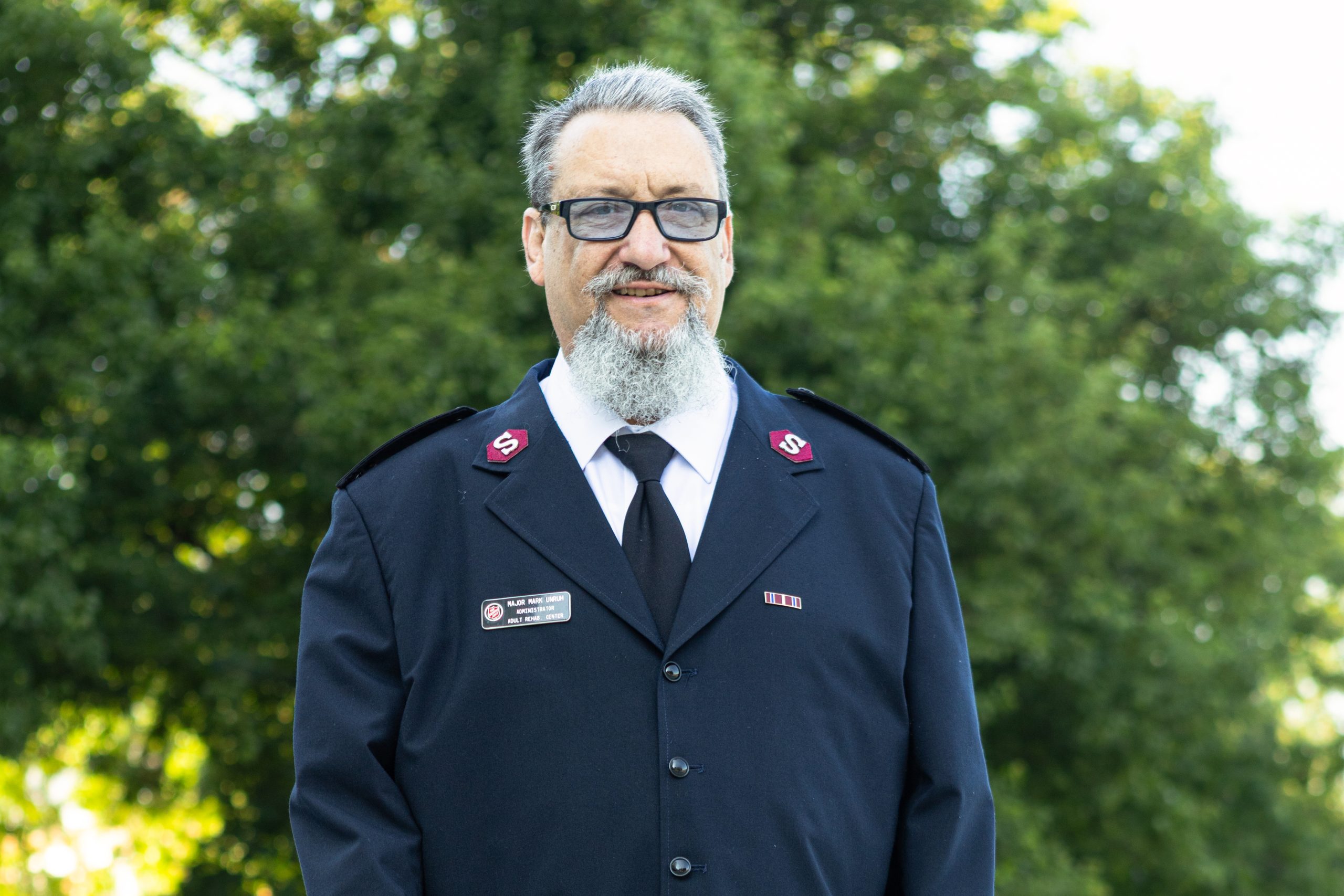
When Major Mark Unruh speaks to substance abusers at a Salvation Army Adult Rehabilitation Center, he commands attention as a former addict who now serves as a longtime officer.
“‘For this son of mine was dead and is alive again; he was lost and is found.’ So they began to celebrate.” —Luke 15:24
Major Mark Unruh can certainly relate to the Parable of the Prodigal Son.
His father, Charles, was a great man of faith and a head deacon, while his mother, Clara, taught Sunday school in Somerton, Pennsylvania, near Philadelphia. All three of his uncles were Baptist ministers. None of that stopped Mark, who retires next year after a 30-year career as a Salvation Army officer, from leaving the church at age 14.
“God was speaking to me, but I wasn’t listening,” Major Mark recalls. “I was rebelling. I rebelled against everything.”
Mark even left school after eighth grade because of undiagnosed attention-deficit/hyperactivity disorder, commonly known as ADHD.
“I refused to go to school because I couldn’t sit in a class,” he says. “If you told me not to do something, and you were my parents or a teacher or something, I was doing the opposite.”
Making bad choices
Mark took his first drink of alcohol and tried marijuana at age 11 or 12. He was arrested at 14 for two counts of auto theft, conspiracy, receiving stolen goods, and concealing a deadly weapon. He surprisingly did no jail time but continued his wayward ways “for fun,” he says.
Though he stayed clean with the law after that episode, Mark began drinking heavily and was in and out of a host of detox centers, hospitals, rehabs, and psychiatric hospitals beginning in 1986. He made good money as a welder but only after consuming enough vodka in the morning to keep his hands from shaking.
“I was a worker,” he says. “I knew how to make money.”
Work came easy. But Mark was drinking a half gallon of vodka a day before someone suggested he needed a longtime program like the Adult Rehabilitation Center (ARC) offered by The Salvation Army.
Mark knew the program was Christian based, but when he entered the Philadelphia ARC, the only thing familiar to him about The Salvation Army was the officer who sat under the L train in Philly playing the keyboard at Christmas. He relapsed after only a couple of months because he didn’t take the program seriously.
“All I wanted to do was graduate, go back to welding, and make money,” Major Mark recalls. “My problem is I would get so drunk I couldn’t work. And then I would lose everything again.
“I had a lot of rebellion growing up, but I knew the Lord. I knew who He was, but I didn’t know Him personally.”
Hitting rock bottom
During the blizzard of ’93, which was dubbed the “Storm of the Century,” Mark was drinking heavily in a rooming house in Wilkes-Barre, Pennsylvania, during yet another relapse. He drank two half gallons of vodka and passed out. He woke up to 2 feet of snow on the ground.
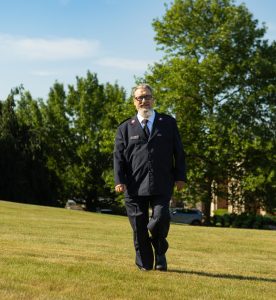
Major Mark Unruh came from a family of pastors and faithful Christians, but he rebelled. “God was speaking to me, but I wasn’t listening,” he says. “I rebelled against everything.” That is, until he came home like the Prodigal Son to make his parents proud. (Photo/Jeff Bruce)
Something clicked and he finally decided to change his life. Mark walked through the deep piles of snow to the nearest detox and called Major Leann Klemowksi, an ARC administrator who prayed and cried with him before putting him on a bus to the Harrisburg ARC. The Prodigal Son was finally going home.
“I prayed that whole way from Wilkes-Barre to Harrisburg,” Major Mark says. “It really hit me that I knew I had to do something. I said to the Lord, ‘Whatever you have for me, I’m ready to do it. I’m ready to go.’ I feel like that’s when I turned it around.”
Mark became a cook at the Harrisburg ARC and began seriously praying, reading his Bible, and going to chapel. One of the “rounders”—someone who jumps from rehab to rehab—told Mark he seemed different as he absorbed the teachings and tried to get closer to God.
“I wasn’t worried about getting out of there and making money. I was finally content,” Major Mark says. “I was able to breathe. I was finally at peace.”
Hearing God’s call
For the first time, Mark began to witness about God’s love, share scripture, and pray with others. He also began to feel a call to ministry, which was confirmed for him when ARC chaplain Major Mary Kapschull shared the words of 2 Corinthians 1: “[God] comforts us in all our troubles, so that we can comfort those in any trouble with the comfort we ourselves receive from God.”
His life was changing and so were his priorities. Mark made the decision to become an officer of The Salvation Army during the ARC holiness retreat in 1993 at Camp Ladore just before he graduated from the program.
“My parents not only got to see me finally go through a program, but they saw me surrender my life, accept Christ, and go into the ministry,” Major Mark says. “It was a blessing for them.”
Today, he enjoys watching others achieve the same success when they complete the program and are reconciled to their families.
While going through the ARC, Mark got involved in nearly every ministry at The Salvation Army in Harrisburg. That’s where he met his future wife, Mary, a third-generation Salvationist who, unlike her husband, had never drank or smoked.
A lifelong ministry partner
The two dated during various outings sponsored by the corps and realized God had put them together.
“We never went anywhere without a chaperone,” Major Mark says. “It was obvious God was putting us together in each other’s life for ministry.”
Major Mary Unruh now calls her husband “my best friend” and “a gift from God” and agrees that God planned for their paths to cross so they could serve Him together.
“His life reflects the redeeming grace and love of our Heavenly Father,” she says of her husband. “Our ministry is about others and showing the joy in our lives every day. Sharing the message of God’s love with the men at the center and seeing the change in their lives is what it’s all about.”
The Unruhs, who married at the ARC in 1994, entered officer training in 1995 and were commissioned as lieutenants two years later. They finish up 30 years of ministry next June after stints at ARCs all over the USA Eastern Territory.
“My husband is my partner in life and in ministry,” says Major Mary. “Every day brings new challenges and adventures, and I can face them because of his support. I do not come from a recovery background, but it doesn’t matter. God uses us in ways we could not imagine or foresee.”
In Christ alone
The couple also served in New Jersey; Portland, Maine; Erie and Scranton, Pennsylvania; and finally Pittsburgh. Major Mark says he and his wife have enjoyed each appointment and seeing families reunited.
“The highs are very high, and the lows are very low,” he says. “We deal with a lot of pain and a lot of death and sickness, but we also get to deal with a lot of victories.”
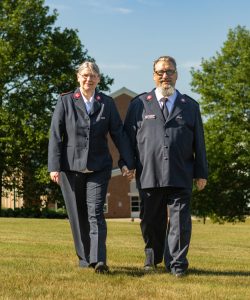
Majors Mark and Mary Unruh have been faithful Salvation Army officers for 30 years. While Major Mark comes from a recovery background, his wife never drank or smoked. (Photo/Jeff Bruce)
The enduring strength of The Salvation Army’s ARC program is that it’s self-supporting, Major Mark says, and staff “can preach the truth” without government interference.
“We don’t have to worry about being told what we can and cannot say as far as when it comes to preaching the gospel and teaching the Bible,” he says.
While the terminology has changed over the years, mostly so insurance will pay for treatment, Major Mark believes man’s sinfulness is the root cause of addiction.
“It’s sin, and I believe some of us are wired differently,” he says. “I think people that are susceptible to addiction are wired in a way where we just seem a little more impulsive. Once something starts, we have a problem stopping. When you look at something addictive, like a substance, that makes it even harder to stop.”
Transformed to new life
Major Mark says while the 12 Steps of Alcoholics Anonymous are useful in rehabilitation, including at the ARC, he preaches Christ and explains the biblical foundation for each step.
“When you take the Lord out of it, you’re really just whittling it down,” he says. “The fellowship is not bad, but it’s really just a club without God being at the center. It’s really just a place for a bunch of people to get together. That’s still a good thing because you’re with people who are like-minded, but you have to have God at the center of it all.”
Major Mark calls Christ the “ultimate answer,” though making a public profession is not necessarily a requirement of the ARC program.
“We ultimately want people to accept Christ,” he says. “Unless there’s a transformation in the way we think, in what we believe, and the way we see the world and each other, you’re just going to continue to be the same person you were. That transformation has to take place.”
While some people can abstain from drugs and alcohol for a while without totally making a commitment to Christ, Major Mark wants to make sure their eternal destiny is set.
“Where are they at beyond the physical? Where are they at spiritually?” he says.
He’s been there
Major Mark believes his past experiences as an addict and ARC graduate have been instrumental in his long career.
“I think that’s why God has me here,” he says. “One thing the guys say when I’m preaching is that it’s relatable. I know where the guys are at and what they’re going through. I sat in that seat many times. I know what it’s like to sit in that chapel and to think about things outside that chapel and not focus. I know what it’s like to want to get out of there. I know everything they’re going through because I went through them myself.”
While he has seen many victories in helping people overcome their addictions, Major Mark takes no credit for any success and gives all the glory to God. He gives the same advice to the men he counsels. Then there are the men who can’t forgive themselves for their sinful past.
“They have to find what I call the ‘healthy middle’ and see God loves them and wants more for their lives,” he says. “It’s a relationship and requires communication. You have to put the time into the relationship.”
Major Mark, 66, plans to serve The Salvation Army in post-retirement in some way, but he also hopes to continue welding and may take some time off to go fishing.
Coming full circle
Major Mark believes it is important to instill self-esteem in the men he counsels, as well as teaching them to work with their hands. He has taught them marketable skills like welding and woodworking. Some have gone on to college and good-paying jobs after leaving the ARC.
“I’m doing my best every day to help people become not just productive members of society, but the husbands, the fathers, the sons that their families deserve to have in their life,” he says. “That’s what I’ve been doing for 30 years now. That’s really what my life has been about.
“Before I came to the program, I hurt a lot of people in my active addiction. It was my goal to try my best for families not to have to go through the same pain my family went through.”
Major Mark credits his parents for their steadfast faith in him over the years. He’s often thought about how his life story mirrors the Parable of the Prodigal Son.
“My mom and dad were both people of faith who believed that at some point God was going to answer their prayers and reach me,” he says. “It was more coming home to God, so I could come home to my parents.”
About the Author: Robert Mitchell